Personal Reflections
Between pluralism and polarization, I have faith in pluralism. Hartmut Behr's book Politics of Difference and his concept of peace in difference resonate with me.
I learn best through peer-to-peer hermeneutical dialogue, an internet connection, and staying skeptical, critically examining AI's responses to my questions and prompts. Using ontology (what is real?) and epistemology (what does it mean to know?), I self-study and, through post-structuralist perspectives 🎭, I piece together information as fragments of the truth trying to avoid apophenia or making connections that don't hold up to logic. I am curious about both the humanities and the sciences. In science (e.g. geology and crystals), we try to interpret the world. In humanities, we are interpreters that try to interpret other interpreters. I study math best by learning about the history of the people behind it and what they were working on (I recommend A History of Mathematics by Carl B. Boyer & Uta C. Merzbach). I believe in creationism, that we are anthropic observers living in a fine-tuned universe, the symmetry and subsequent matter-antimatter asymmetry of baryogengesis, emergent gravity (it's a push from entropy, not a pull from mass), modified Newtonian dynamics (MOND), string theory, abiogenesis (from dust to dust [Genesis 3:19]), the hologenome theory of evolution, the law of increasing complexity, and epiplexity. I love reading research from the Santa Fe Institute and I wish to see the bison on the prairie at Fermilab someday. Jennet Conant’s book Tuxedo Park and Ananyo Bhattacharya’s The Man from the Future are great. I'm shocked at the throughline of meteorology between Lewis Fry Richardson, John von Neumann, and Edward Lorenz. It makes sense because analyzing the complexity of the climate requires theoretical mathematics and computing. The technology that comes out of environmental science is awesome. Weather modification (e.g. cloud seeding) can be used virtuously.
Innovation is creatively destructive. Small businesses can disrupt monopolies with intelligence. I have been educated by the stories of François Xavier d'Entrecolles' exposing of the secret of fine china (porcelain) and Pierre Poivre’s ending of the Dutch East India Company’s monopolistic exploitation of the people and resources of the Banda Islands. I find the story of how the pistachio nut came to California from Iran interesting. The French School of Economic Warfare and the Jeune École are interesting.
I edited the intelligence cycle graphic from Wikipedia and generated this butterfly effect graphic with Google Gemini. There is some consensus that thinking is fundamentally built on heuristics (mental shortcuts) and that the rational actor model of our behavior is inaccurate. While the Swiss Federal Intelligence Service handbook on cognitive bias treats these as systematic errors requiring slow, deliberate analysis to fix (theorized by Kahneman and Tversky, applied to behavioral economics by Thaler), Collins argues heuristics are adaptive tools suggesting we shouldn't just try to de-bias ourselves, but rather understand why our shortcuts work in some contexts and fail in others (theorized by Gigerenzer).
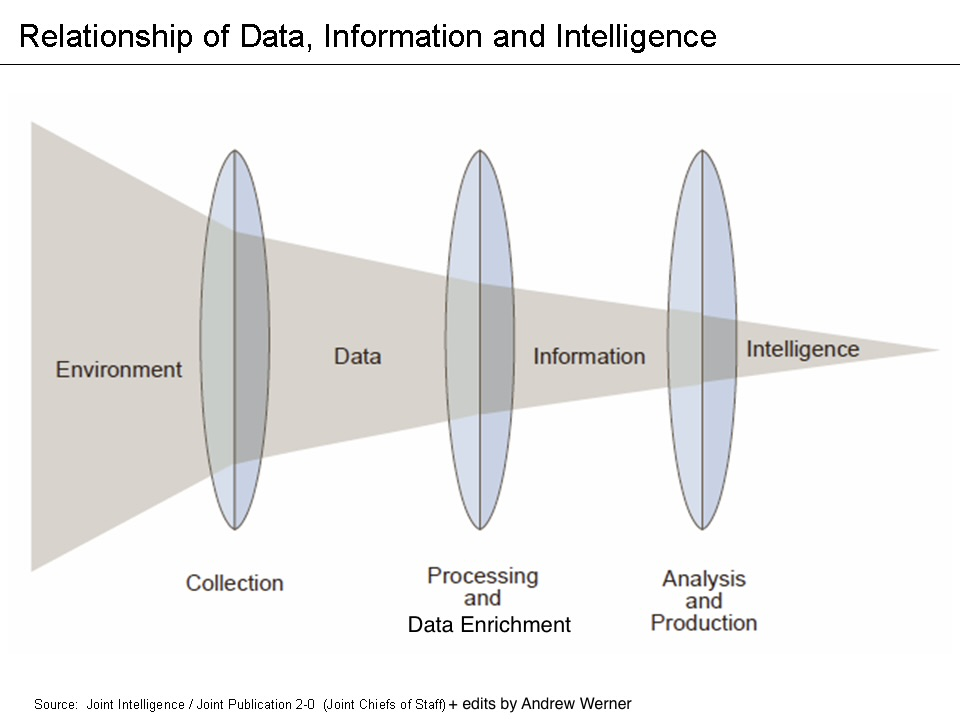

We are all connected in this environment. Butterfly effects emerge from our anthropogenic activities. I think about Ubuntu's "I am because we are" and the importance of collaboration moreso than great people. In the complexity of our relations is where my faith, hope, love, and charity emerges.
The Wikimedia Foundation taught me that over 7,000 languages are spoken around the globe, and the vast majority of them are oral and never written. There's so much information to receive. Are these languages gendered? What beliefs do they encode? How are they used to resolve conflict? This descriptive work leads to a normative question: on what basis do we interact with each other? The tension between universalism and pluralism is often manageable through relationalism. Healthcare and caring for one another when ill despite difference (the "into whatsoever houses I enter, I will enter to help the sick, ... bond or free [abstaining from intentional wrong or abuse]" part of the Hippocratic Oath [not everybody everywhere agrees on the same oath]), for instance, reflects a universal human dignity, navigates pluralistic beliefs, yet ultimately depends on the relational work of care.
The history of the Aramaic word "Ephphatha" ("be opened") spoken by Jesus to a deaf man (Mark 7:34), His parable of the Grain of Wheat, The Book of Divine Works, and the Platonist, divine conceptualist depiction of creation in the Bible moralisée are powerful. I find the difference between the two works in the depiction of Our Father interesting. I see the edges of the tapestries as the horizon of what we can know before perhaps the world to come.
The closest Jesus came to violence was furnishing a whip that He did not use on a person (John 2:15). For that, I disagree with John Brown's violence even though his fight against slavery was very honorable. We are humans, not property. We were told by Jesus to love ourselves and our neighbors. Love should never feel like slavery.
Jesus' parable of the Lost Sheep comes to mind when I read about liberation theology. It intersects ingroups and the oppression of outgroups, politics, economics, society, and more. "Liberate" is a verb. Its action affects the world and may be described as disruptive.
I believe in the Immaculate Heart and Immaculate Conception of Our Lady of Guadalupe (that is Mary, mother of Jesus — her Basilica in Mexico is beautiful). When I read about the history of the ancient Maya and their belief in Flower Worlds (LiDAR's use in Mayan archaeology is cool), I think about Justin Martyr’s thoughts on "seeds of" the Logos. I believe that only God knows everything (omniscience). Augustine of Hippo's teachings for sinners and saints to share the same church is resonated by Abigail von Buren's, "A church is a hospital for sinners, not a museum for saints." Disagreeing with Pelagius, I believe in the original sin and the Fall. Inspired by Pope John Paul II’s call to breathe both the Western and Eastern churches as one set of lungs, and Pope Leo XIV's call for full communion with the Orthodox Church (I admit I don't know much about the schism beyond the disagreement over the inclusion of "filioque" in the Nicene Creed [that the Holy Spirit proceeds from not only the Father, but the Son too] and the Ecumenical Patriarch of Constantinople [I love the etymology of ecumenism being a universally shared world, a shared house] being the first among equals of the multiple patriarchs of the Eastern Orthodoxy Church), I am reading Anna M. Silvas’s translation of The Rule of St. Basil in Latin and English. Pontifex means "bridge-builder" in Latin. From my limited understanding, when Jesus gave his disciple Simon a new title to signify his role as the foundational rock of the early church, He called him Kepha [כיפא] (John 1:42) [it wasn't until the Tyndale Bible that the Bible was translated into English]. In Aramaic, Kepha [כיפא] means "rock" or "stone". When the New Testament was written and translated into Greek [the Septuagint is the Greek translation of the Old Testament which predates the Masoretic Text of the Tanach (I got that spelling from ArtScroll)], the Aramaic Kepha had to be adapted. Petra (πέτρα) is the literal Greek translation of the word, meaning a large, solid rock or bedrock. Petra is a feminine noun in Greek, and so it wasn't suitable as a name for a man. To give the name a masculine ending, the Greek text used Petros (Πέτρος), which became "Peter" in English. I personally believe in the Apostolic Succession of the Bishop of Rome, the pope, despite the saeculum obscurum. Even the pope experiences concupiscence and desire, even he sins, papal infallibility is conditional on ex cathedra.
I see Eun-Sil Son’s work Sola fide or fide caritate formata: Two incompatible principles? From Martin Luther to Thomas Aquinas as a metaphysical bridge between my Lutheran friends' sola fide (justification through “faith alone”) and the Roman Catholic “fide caritate formata” (justification through faith formed by love), as through faith (our faith and the faith of those who nurture us as babies), we receive the sacrament of baptism (I was baptized in the suburbs of Houston, Texas), our branches are grafted onto Jesus’ vine (Romans 11:17), love flows from His Sacred Heart, and if we are receptive with faith, love forms us to be virtuous. We fall, but through the gift of faith we face contrition and repent. I think Thomas Aquinas and Martin Luther explain the same phenomenon in their own ways. Our same world is disclosed in unique ways to each of us. Relational reading and writing seem to be useful skills for "keep[ing] the cycle of interpretations, creations of meanings, and their exegeses open, evolving, and permanently ongoing" (Behr, 2014, p. 10 of Politics of Difference: Epistemologies of Peace). Instead of trying to solve human interactions like math problems, I think we should treat them like ongoing conversations where no one ever gets the final word. Counting 2 Maccabees as part of the deuterocanonical books lets me, through whatever politics, pray for the dead regardless of differences in beliefs.
The preservation of the Temple Mount, the Church of the Holy Sepulchre, the Stations of the Cross, and Calvary (the site of Jesus' crucifixion) assists me in my faith. I am curious about the historical prevalance of Buddhist ideas around the region of the Holy Land. Religion and the Subtle Body in Asia and the West: Between Mind and Body by Geoffrey Samuel and Jay Johnston looks interesting.
In the beginning there was one piece of information, one Word, and the Word was God (John 1:1), referring to Jesus, the Son, with His Sacred Heart, Who we receive, and was born by the Power of the Holy Spirit through the consensual consecration of the Virgin Mary to the Father of the Uni-Verse🌌🎤 with all of His baryonic acoustics🎶 and harmonics🎵. He willingly gave Himself upon the cross at Calvary for the sake of the forgiveness of our sins. The Holy Spirit surrounds us. He really is everywhere and within everything and everybody. I see that use of the metaphysical “one Word” like the symmetry of baryogengesis, though it is He, that is the Creator of the universe, The Father, whom we are made in the image of, that willed baryogengesis to unfold, and then the subsequent matter-antimatter asymmetry (the apparent occurence of more matter than antimatter in our universe) is all the pieces of quantum information that emerge in the complexity of His all knowing predetermined plan for the creation of this fine-tuned universe with us anthropic observers in it. Dust to dust (Genesis 3:19). We came from dust through abiogenesis and emergent gravity and our hologenome evolution, and we will return to dust in the heat death model of the universe (does it all get pooled into the singularity of another black hole? Into the creation another universe?) we make sense of what is above us with our observations.
I think we are more than minds and bodies. We have souls. I think maybe the resurrection is transcendent of matter? We don’t have Jesus’ bones it's one of the mysteries of faith. He went up. That's what I know. We don't know the science of how it happened. Maybe the matter was annihilated by antimatter (given He willed baryogenesis and the creation of the universe, I think He could will this too) and that's why we can't find the atoms. I believe in the resurrection of the body, but I don't know that it's atoms in Heaven.
For a moment I thought that The Father wills everything even down to the communication of biological cells in our brains and every thought we have, but I've come to think that we share in His creation. He created everything, breathed life into us, and we are free to shape the world and ourselves. We have free will and agency in a covenant with God. Whether or not we’re tuned into our higher purpose is another story. Since the Fall, our connection to Him can feel like tuning an old television or radio amidst the noisy interference of the world. We adjust our ontological antennae with our hermeneutics to tune into the clean signal. It's like trying to peer into light that has been refracted through a prism. His divine illumination lights the lanterns of our hearts ❤️🔥 which are chiseled by contrition. Sometimes I am hypervigilant and it helps for me to remember that we form our strongest emotional bonds in vulnerability. Where we are broken is where the light shines through.

Part of my journey to becoming more faithful has giving my attention to the gospel readings about artworks (e.g. Van Gogh's Sunflowers) from the christian.art team (a Westminister Cathedral non-profit). Carlo Acutis’ website miracolieucaristici.org made me believe in miracles, and his naming of the Eucharist the “Highway to Heaven” makes me smile. I think about Michael Slote’s From Enlightenment to Receptivity when I receive communion. It isn't disgraceful at all to be a fool for Christ. It's pitiful and deserves compassion and sympathetic sorrow. I know the anointing of the sick to be respected and the history of Anthony of Kiev to be real, and I'm amazed that Joseph of Cupertino really flew.
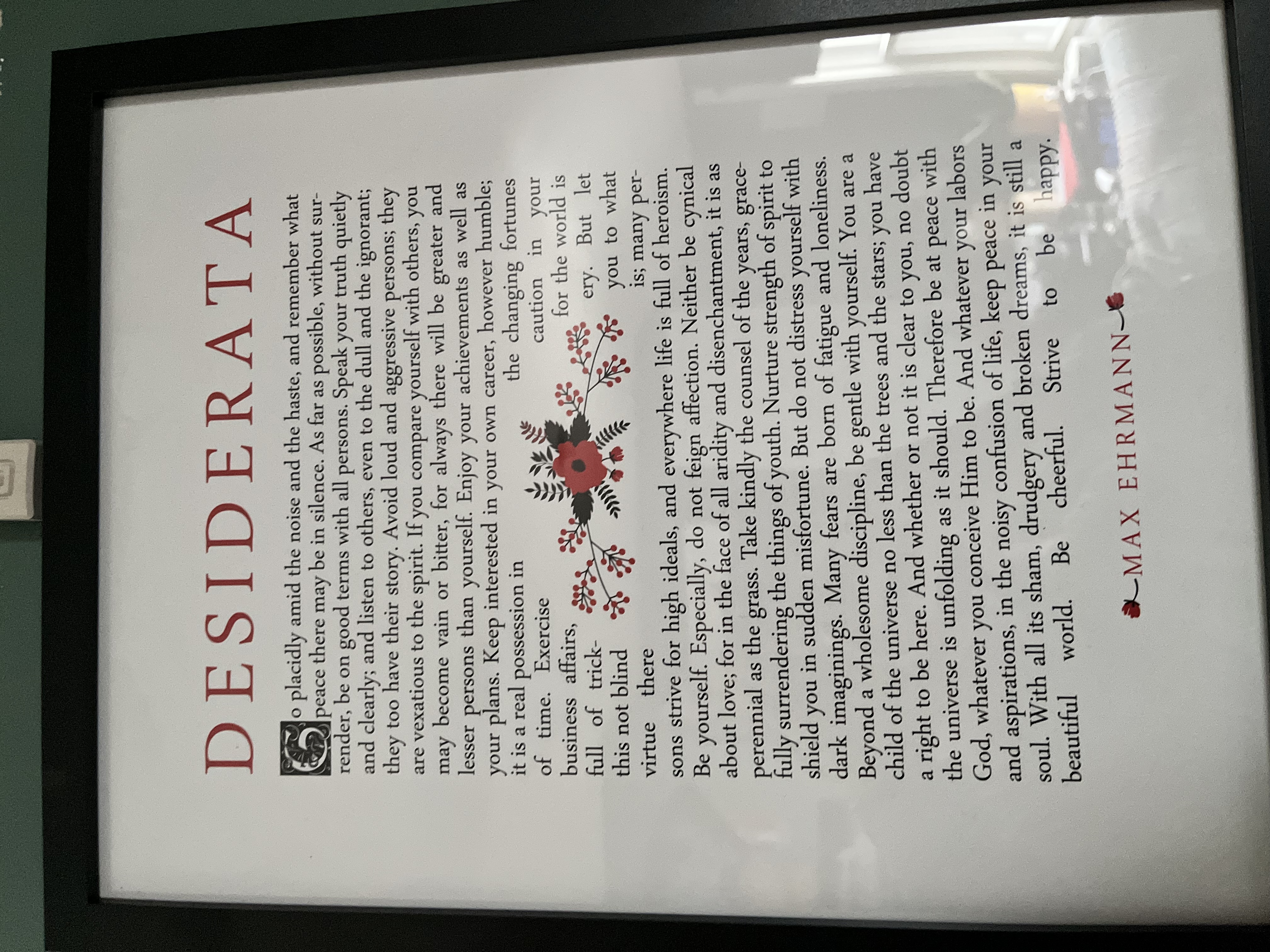
Every possibility is only a series of events away. I am thankful that I am fortunate to have intelligent and loving friends, family, and a home.
✞